
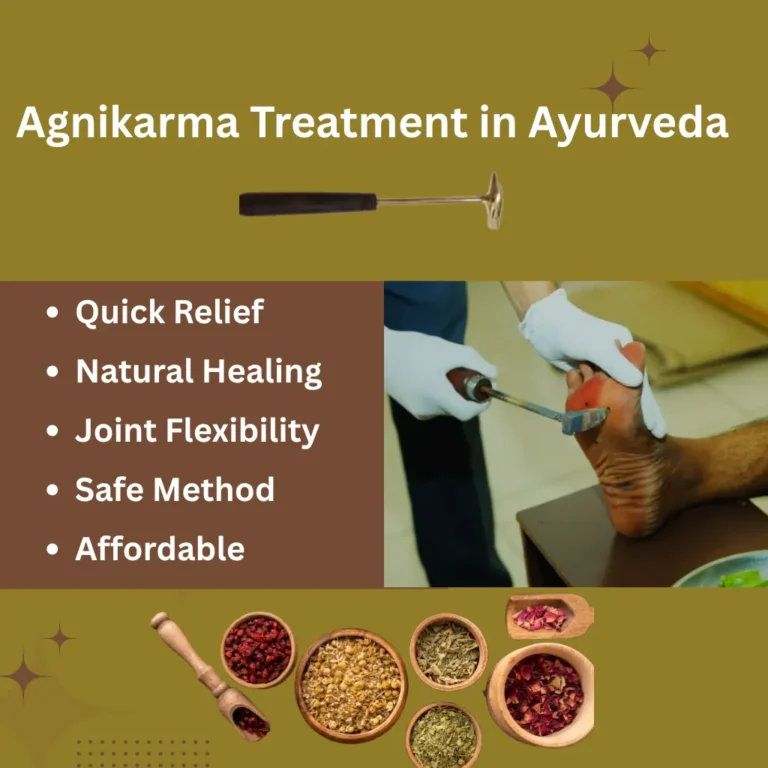
Agnikarma Treatment in Ayurveda: Benefits, Procedure & Cost Explained
Chronic pain is one of the most common health problems today. Many people struggle with joint stiffness, heel pain, sciatica, or frozen shoulder—and often rely on painkillers that only give temporary relief. Ayurveda offers a natural, effective, and long-lasting solution through Agnikarma, a unique para-surgical procedure described in the ancient texts like Sushruta Samhita.
If you’ve ever wondered “What is Agnikarma treatment?”, how it works, and whether it can help you, this detailed guide covers everything—from its benefits and procedure to cost, safety, and FAQs.
What is Agnikarma in Ayurveda?
Agnikarma (अग्निकर्म) is a specialized para-surgical procedure in Ayurveda that uses controlled therapeutic heat to treat various pain-related and musculoskeletal disorders. The term “Agni” means fire (heat) and “Karma” means action or therapy, so Agnikarma literally translates to therapy through heat.
This treatment involves applying heat at specific points on the body using a heated metal rod (Shalaka) or herbal sticks, depending on the condition. The purpose is to alleviate pain, dissolve toxins, and restore dosha balance without any invasive surgery.
Origin and References in Ayurveda
Agnikarma has been described extensively in ancient Ayurvedic texts like:
-
Sushruta Samhita – Known as the father of surgery in Ayurveda, Sushruta explained Agnikarma as an effective measure for chronic and localized pain conditions.
-
Charaka Samhita – Mentions the role of heat in balancing aggravated Vata and Kapha doshas.
According to Ayurveda, when Vata and Kapha doshas become imbalanced, they obstruct channels, cause stiffness, and lead to severe pain. Heat (Agni) has a natural property of alleviating Vata and Kapha, making Agnikarma an ideal therapy for such conditions.
Key Principle of Agnikarma
-
Vata and Kapha Disorders: Most pain conditions are dominated by these two doshas.
-
Heat as Medicine: Applying controlled heat to affected points helps open blocked channels (Srotas), reduces stiffness, and restores normal function.
-
Removal of Ama (toxins): Localized heat helps break down accumulated toxins that contribute to inflammation and pain.
-
Improved Circulation: The therapy enhances local blood flow, which accelerates healing and reduces discomfort.
Why Choose Agnikarma?
-
Immediate Relief: Unlike oral medicines that take time, Agnikarma often provides instant relief from pain.
-
Minimally Invasive: No surgery, no hospitalization—safe for most patients.
-
Natural & Holistic: Uses natural principles without harmful chemicals.
-
Quick Recovery: Most people can return to normal activities soon after the session.
Agnikarma is widely regarded as a safe, effective, and time-tested Ayurvedic solution for chronic pain management, making it a preferred choice for those seeking natural healing methods.
Also Read: What is Agnikarma & Procedure
Benefits of Agnikarma Therapy
Agnikarma is one of the most trusted Ayurvedic treatments for managing chronic pain and musculoskeletal disorders. This therapy is gaining popularity because it offers natural, fast, and long-lasting relief without the side effects associated with modern painkillers. Here are the key benefits explained in detail:
1. Quick Pain Relief
One of the most remarkable benefits of Agnikarma is the instant reduction in pain after the very first session. By applying controlled heat to specific points, the therapy stimulates nerve endings, improves blood flow, and reduces inflammation, resulting in noticeable relief within minutes for many patients.
2. Improves Joint Function
Stiffness in joints is a common symptom in conditions like arthritis, frozen shoulder, or spondylosis. Agnikarma works by:
-
Softening the surrounding tissues.
-
Reducing stiffness.
-
Restoring normal joint movements.
Patients often report better flexibility and ease of movement after completing a few sessions.
3. Balances Vata and Kapha Doshas
According to Ayurveda, pain and stiffness are usually linked to Vata (dryness, movement) and Kapha (heaviness, congestion) imbalances. The heat energy (Agni) used in Agnikarma directly counters these doshas, bringing them back to a natural state of balance.
4. Enhances Local Blood Circulation
Heat therapy in Agnikarma dilates blood vessels, increasing blood supply to the affected area. This:
-
Promotes oxygen and nutrient delivery.
-
Speeds up the removal of toxins (Ama).
-
Accelerates tissue repair and healing.
5. Reduces Dependency on Painkillers
Modern painkillers only mask symptoms and often come with side effects like acidity or kidney stress. Agnikarma provides natural and sustainable relief, reducing the need for long-term medications and improving overall well-being.
Additional Advantages
-
No Surgery Required: Minimally invasive and safe when performed by a qualified Ayurvedic doctor.
-
Cost-Effective: Affordable compared to long-term medication or surgeries.
-
Quick Recovery: No downtime; patients can resume daily activities almost immediately.
Conditions Treated by Agnikarma
Agnikarma is highly effective in conditions where pain, stiffness, and reduced mobility are the primary concerns. It is particularly recommended for Vata and Kapha dominated disorders, which often lead to chronic musculoskeletal problems. Below are the major health issues where Agnikarma delivers noticeable results:
1. Osteoarthritis (Sandhigata Vata) – Especially Knee Pain
Osteoarthritis is one of the most common reasons people choose Agnikarma. In Ayurveda, it is termed Sandhigata Vata, where the degeneration of cartilage and joint tissues leads to pain, swelling, and restricted movement.
How Agnikarma Helps:
-
Reduces inflammation and stiffness in the knee joint.
-
Improves blood circulation to cartilage and ligaments.
-
Provides quick relief from pain without harmful painkillers.
2. Heel Pain (Calcaneal Spur)
Heel pain caused by calcaneal spur or plantar fasciitis is a severe, stabbing pain in the heel, especially during the first steps in the morning.
How Agnikarma Helps:
-
Dissolves local Ama (toxins) causing inflammation.
-
Relieves sharp pain and supports better foot function.
-
Often recommended when other conservative therapies fail.
3. Sciatica (Gridhrasi)
Sciatica refers to pain radiating from the lower back down to the legs due to irritation of the sciatic nerve. In Ayurveda, it is known as Gridhrasi.
How Agnikarma Helps:
-
Reduces nerve compression and inflammation.
-
Relieves radiating pain and tingling sensations.
-
Enhances local circulation to support nerve healing.
4. Cervical Spondylosis
Cervical spondylosis is age-related wear and tear in the neck region leading to stiffness, headaches, and shoulder pain.
How Agnikarma Helps:
-
Relieves muscular tension in the neck.
-
Improves mobility and flexibility.
-
Beneficial for those with chronic neck pain from desk jobs.
5. Lumbar Spondylosis (Lower Back Pain)
Lower back pain, often due to lumbar spondylosis, is extremely common in today’s sedentary lifestyle.
How Agnikarma Helps:
-
Reduces stiffness in the lumbar spine.
-
Alleviates chronic pain and discomfort.
-
Promotes easy bending and sitting movements.
6. Frozen Shoulder (Avabahuka)
Frozen shoulder is characterized by restricted shoulder movements and severe pain.
How Agnikarma Helps:
-
Reduces stiffness in shoulder muscles.
-
Improves range of motion.
-
Gives long-lasting relief when combined with physiotherapy and Ayurvedic oils.
7. Tennis Elbow (Kurpara Sandhigata Vata)
Tennis elbow causes pain around the outer part of the elbow, often due to overuse or strain.
How Agnikarma Helps:
-
Relieves localized inflammation.
-
Promotes healing of soft tissues.
-
Reduces pain during gripping and lifting.
Other Indications
-
Migraine and chronic headaches (select cases).
-
Corns and warts (with modified Agnikarma techniques).
-
Certain skin disorders (as per classical references).
Agnikarma Procedure: Step-by-Step Guide
Agnikarma is a highly specialized Ayurvedic therapy that must be performed by a qualified Ayurvedic doctor under strict hygienic and controlled conditions. The procedure is simple, safe, and minimally invasive when done correctly. Below is a detailed explanation of how Agnikarma is performed:
1. Patient Assessment
Before starting the procedure, the Ayurvedic physician conducts a comprehensive examination, which includes:
-
Evaluating the patient’s Prakriti (body constitution).
-
Assessing the severity, duration, and nature of pain.
-
Identifying the exact dosha imbalance (Vata-Kapha dominance).
-
Locating the precise points or regions to apply Agnikarma.
This step ensures that the therapy is personalized for maximum effectiveness.
2. Preparation of the Patient and Instruments
-
The affected area is thoroughly cleaned and sterilized to avoid infections.
-
Marking the points where heat will be applied.
-
A special metallic rod known as Shalaka, usually made of Panchadhatu (an alloy of five metals – gold, silver, copper, iron, and zinc), is heated to the required temperature.
(In some cases, herbal sticks or gold sticks may also be used for specific conditions.) -
The patient is positioned comfortably to ensure proper access to the affected region.
3. Application of Heat
-
The heated Shalaka is gently and quickly touched on the marked points of the skin for a fraction of a second.
-
The number of touches depends on:
-
Size of the affected area.
-
Severity of the condition.
-
-
Quick contact ensures minimal discomfort while delivering therapeutic heat deep into the tissues.
4. Post-Procedure Care
-
Immediately after application, the treated points are coated with:
-
Herbal pastes (usually containing ghee, sandalwood, or aloe vera).
-
These help cool the area, prevent burns, and promote healing.
-
-
The patient is instructed to:
-
Avoid water or washing the area for 12 hours.
-
Refrain from scratching or rubbing the treated points.
-
Apply prescribed herbal ointments as advised by the doctor.
-
Duration of the Procedure
-
A typical Agnikarma session lasts 15 to 30 minutes, including preparation and aftercare.
-
Most patients can resume normal activities immediately after the session.
Safety Precautions
-
Agnikarma should only be performed by an experienced Ayurvedic doctor.
-
Proper sterilization of instruments and controlled heating are essential.
-
Mild redness may occur initially but subsides within 24–48 hours.
Duration & Number of Sessions for Agnikarma
One of the advantages of Agnikarma therapy is that it is time-efficient and offers quick relief compared to conventional treatments.
-
Session Duration:
Each Agnikarma session typically lasts 15 to 30 minutes, including preparation, application, and post-care. -
Number of Sessions:
Most patients experience significant improvement after 3 to 7 sessions, but the exact number depends on:-
Severity of the condition.
-
Chronicity (how long you’ve had the problem).
-
Body constitution and healing response.
-
-
Session Interval:
Sessions are usually scheduled on alternate days or twice a week for best results.
Is Agnikarma Painful?
Many people hesitate because they fear the procedure might hurt. The good news is:
-
Agnikarma is almost painless when done by a trained Ayurvedic doctor.
-
You may feel a slight pinching or heat sensation for a split second during the application, but it subsides quickly.
-
Most patients report that the relief from pain outweighs the minimal discomfort experienced during the therapy.
Safety & Possible Side Effects
Agnikarma is considered safe and effective, provided it is done by a qualified Ayurvedic practitioner in a hygienic setting.
-
No Major Side Effects:
When proper guidelines are followed, there are no serious complications. -
Minor Reactions:
-
Mild redness or tenderness at the application site (heals within 24–48 hours).
-
Rarely, small scabs may form, which fall off naturally.
-
-
Precautions:
-
Do not wash the treated area for 12 hours.
-
Avoid scratching or rubbing the site.
-
Apply the prescribed herbal cooling paste or ghee as directed.
-
Cost of Agnikarma Treatment in India
Agnikarma is affordable compared to surgical or long-term pain management options. However, the cost varies based on:
-
The city and clinic reputation.
-
The experience of the Ayurvedic doctor.
-
The number of sessions required.
Average Cost Breakdown:
-
Per Session: ₹500 – ₹2,000
-
Full Package (3–7 sessions): ₹3,000 – ₹10,000
💡 Tip: Always choose a certified Ayurvedic clinic with proper sterilization and experienced doctors to ensure safe and effective treatment.
Agnikarma vs Viddha Karma – What’s the Difference?
Both Agnikarma and Viddha Karma are para-surgical procedures described in classical Ayurvedic texts, primarily used for managing pain and chronic conditions. While they share a common goal of restoring balance and health, the techniques and indications differ significantly. Understanding these differences helps patients choose the right treatment for their condition.
1. Method
-
Agnikarma:
This therapy uses controlled heat application (thermal cauterization) on specific body points to reduce pain and stiffness. Heat penetrates deeply into tissues, helping dissolve toxins and improve circulation. -
Viddha Karma:
Viddha Karma, on the other hand, involves bloodletting using fine needles or syringes at specific points. The aim is to remove vitiated blood (Dushta Rakta), which is considered a root cause of many diseases in Ayurveda.
2. Purpose
-
Agnikarma:
Primarily for instant pain relief and mobility restoration. It works on Vata and Kapha disorders, where cold, stiffness, and blockages cause discomfort. -
Viddha Karma:
Focused on blood purification and improving circulation by draining out impure blood, thereby reducing inflammation and preventing tissue damage.
3. Conditions Treated
-
Agnikarma:
-
Joint pain (knee, shoulder, elbow)
-
Sciatica
-
Heel pain (Calcaneal spur)
-
Frozen shoulder
-
Lumbar and cervical spondylosis
-
-
Viddha Karma:
-
Varicose veins
-
Abscesses
-
Certain skin disorders
-
Migraine (in selected cases)
-
Hypertension-related complications (as per classical texts)
-
4. Invasiveness and Recovery
-
Agnikarma:
-
Minimally invasive.
-
No significant downtime; patients can resume activities almost immediately.
-
-
Viddha Karma:
-
Slightly more invasive since it involves puncturing veins or blood vessels.
-
Requires more aftercare to prevent infections.
-
Summary Table
| Aspect | Agnikarma | Viddha Karma |
|---|---|---|
| Method | Thermal cauterization | Bloodletting using needles |
| Purpose | Pain relief through heat | Removes vitiated blood |
| Primary Action | Balances Vata and Kapha | Purifies blood (Raktha Shodhana) |
| Conditions | Joint pain, stiffness, sciatica | Varicose veins, abscess, skin issues |
Who Should Avoid Agnikarma?
-
People with Pitta dominance or skin sensitivity.
-
Patients with bleeding disorders.
-
Pregnant women.
-
Children and very elderly individuals (unless advised by a doctor).
Home Care After Agnikarma: Do’s and Don’ts
Proper aftercare is essential for the effectiveness and safety of Agnikarma therapy. Following the doctor’s advice helps in faster healing, preventing infection, and maintaining results. Here are the important guidelines every patient should follow:
Do’s
-
Keep the Area Dry for 12 Hours
Avoid washing the treated area immediately after the procedure. Exposure to water can irritate the skin and delay healing. -
Apply Prescribed Herbal Ointment or Ghee
Ayurvedic doctors usually recommend a cooling paste or medicated ghee to:-
Prevent burning sensation.
-
Soothe the skin.
-
Promote natural healing.
-
-
Follow a Light, Dosha-Balancing Diet
-
For Vata issues (joint pain): Include warm, cooked, and oily foods.
-
For Kapha issues (stiffness): Opt for light, warm, and spice-infused meals.
-
Avoid junk food, excess sugar, and processed items.
-
-
Stay Hydrated and Rest
Allow your body to recover. Drink warm water and herbal teas for detoxification.
Don’ts
-
Do Not Scratch or Rub the Area
Scratching can cause irritation and slow down the healing process. -
Avoid Direct Sunlight or Heat Exposure
Protect the treated skin from harsh sunlight or heat to prevent irritation. -
Skip Heavy Exercise for a Day
Avoid strenuous movements involving the treated part for at least 24 hours.
Why Aftercare Matters
Following these aftercare tips ensures:
-
No secondary infection.
-
Faster skin recovery.
-
Sustained pain relief.
FAQs
Agnikarma is used to treat chronic pain conditions like knee pain, sciatica, heel pain, and frozen shoulder.
No, it is generally painless when done by an expert.
Usually 3–7 sessions, depending on the condition.
No major side effects, except mild redness which heals quickly.
It provides significant relief in arthritis pain and stiffness but should be combined with diet and lifestyle changes for best results.
Conclusion
Agnikarma is an effective, safe, and time-tested Ayurvedic solution for chronic pain management. Unlike painkillers that only mask symptoms, Agnikarma targets the root cause by balancing doshas and improving circulation.
If you are suffering from persistent joint pain, sciatica, or heel pain, consult a qualified Ayurvedic doctor for Agnikarma therapy. It’s natural, quick, and highly effective.
👉 Looking for expert Agnikarma therapy? Book an appointment with Devkalp Ayurveda today!
About the Author

Ayurvedic Doctor | 15+ Years Experience | General Physician and Panchakarma Specialist
Dr. Dinesh Kumar is a qualified Ayurvedic doctor with over 15 years of experience in holistic physician and Panchakarma therapies. He specializes in natural treatments for skin, orthopedic, and lifestyle-related issues.
Clinic: Devkalp Ayurveda | Website: devkalpayurveda.com


