
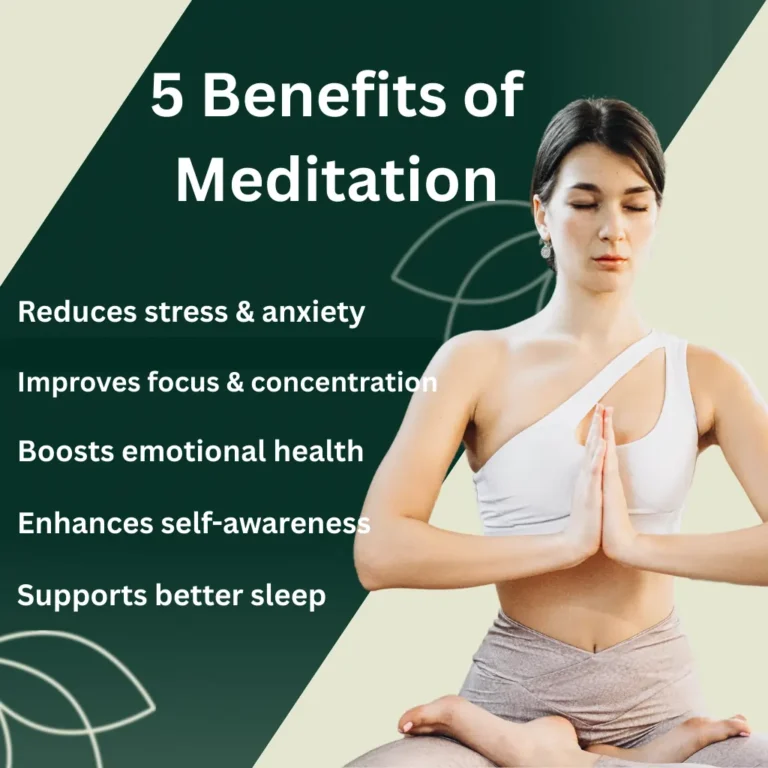
5 Benefits of Meditation for Mind & Body – Science-Backed Guide
Have you ever felt like your brain is a web browser with 100 tabs open at the same time, each one demanding your attention? Between constant notifications, endless work deadlines, family responsibilities, and an overwhelming stream of news, our minds rarely get the chance to pause and breathe. This constant mental overload can leave you drained, unfocused, and emotionally exhausted. That’s why understanding the 5 benefits of meditation is more important than ever — because this simple practice could be the game-changer your mind and body need.
It’s no wonder that stress, anxiety, and burnout have become almost normalised in today’s world. Our schedules are packed, yet our inner peace is running on empty. But what if there was a timeless, scientifically proven method to slow down, clear the mental clutter, and reconnect with yourself — without needing expensive equipment, exotic retreats, or hours of free time?
That’s where meditation comes in. Rooted in ancient wisdom and practiced across cultures for thousands of years, meditation has long been a path to spiritual growth, emotional balance, and inner calm. Today, modern neuroscience and psychology confirm what ancient traditions always knew — meditation can transform not just your mood, but your brain, your health, and even how you respond to life’s challenges.
In this guide, we’ll explore the 5 key benefits of meditation, supported by research, real-life success stories, and practical tips. By the end, you’ll know exactly how to start your own meditation practice — and how just a few minutes a day can create positive ripples across your entire life.
Also Read: Yoga for Back Pain Relief
What is Meditation?
Meditation is a mind-training practice where you focus your attention and awareness on a specific object, thought, or activity — often the breath — to achieve mental clarity, emotional calm, and stability.
Forms of meditation include:
-
Mindfulness meditation – focusing on the present moment without judgment.
-
Transcendental meditation – using mantras to go beyond thought.
-
Guided meditation – listening to a teacher or audio guide.
-
Loving-kindness meditation – cultivating compassion toward yourself and others.
The roots of meditation can be traced back over 5,000 years to ancient India, where it was a central part of Ayurvedic healing and spiritual practices like yoga. Today, it’s embraced by athletes, CEOs, therapists, and even schools worldwide.
Also Read: 7 Powerful Ayurvedic Herbs for Brain Health
How Meditation Works (Science Made Simple)
When you meditate, you’re not just “relaxing” — you’re actually retraining and rewiring your brain in ways that scientists can now measure. Think of it like a workout, but instead of lifting weights for your body, you’re strengthening and reshaping the neural pathways in your mind.
Modern neuroscience has used advanced imaging tools, like MRI scans, to uncover exactly what happens when you meditate regularly:
-
Shrinks the amygdala – This is the brain’s fear and stress center. A smaller amygdala means you’re less reactive to stress and can stay calmer under pressure.
-
Thickens the prefrontal cortex – This area controls decision-making, focus, and problem-solving. A stronger prefrontal cortex helps you think more clearly, even in chaotic situations.
-
Increases gray matter density – Gray matter is linked to memory, learning, and emotional regulation. More gray matter means you process information better and react more thoughtfully.
But meditation doesn’t just change your brain — it also affects your entire body. When you practice, you activate the parasympathetic nervous system (often called the “rest and digest” mode). This leads to:
-
Lower heart rate and blood pressure
-
Balanced hormone levels, including reduced cortisol (stress hormone)
-
A stronger immune system response
One of the most fascinating findings comes from a Harvard Medical School study, which discovered that just 8 weeks of mindfulness meditation led to measurable changes in brain regions linked to memory, empathy, self-awareness, and stress control. In other words, you don’t have to meditate for years to see benefits — your brain can start changing for the better in just two months.
Simple takeaway: Meditation is more than a mental break. It’s a science-backed way to reshape your brain and body so you can respond to life with more clarity, calm, and resilience.
The 5 Benefits of Meditation
1. Reduces Stress & Anxiety
If you’ve ever been told to “just relax” while you’re stressed, you know it’s not that simple. Meditation gives you a practical, repeatable tool to reduce stress.
A study by the National Center for Complementary and Integrative Health (NCCIH) found that regular meditation lowers cortisol — the body’s primary stress hormone.
Real-world example:
Priya, a 32-year-old IT professional, was feeling overwhelmed by her workload. She started taking two 10-minute mindfulness breaks during her day. Within a month, she noticed her headaches reduced, she slept better, and her productivity improved.
Pro Tip: Start your day with a short breathing meditation to set a calm tone before the rush begins.
2. Improves Focus & Concentration
With social media, endless emails, and constant pings, our attention spans are shrinking. Meditation acts like a workout for your brain’s focus muscle.
According to a University of California, Santa Barbara study, students who practiced mindfulness meditation for two weeks scored 20% higher on memory and focus tests.
Real-world example:
Arjun, a college student preparing for competitive exams, used meditation to manage distractions. He practiced 15 minutes of breath awareness every morning. Over time, he found it easier to stay focused for hours without constantly checking his phone.
💡 Pro Tip: Before starting work, close your eyes and take 10 slow breaths. It trains your brain to shift into “deep work” mode.
3. Boosts Emotional Health
Meditation isn’t just about calming the mind — it can reshape your emotional patterns.
Research in the journal Psychiatry Research shows meditation increases serotonin and dopamine — chemicals linked to happiness and well-being.
Real-world example:
Nisha, a new mother, was experiencing postpartum mood swings. She began practicing loving-kindness meditation, where she visualized sending compassion to herself and others. Within weeks, she felt more patient, emotionally stable, and connected to her baby.
Pro Tip: Use guided meditations focused on gratitude or compassion to boost mood naturally.
4. Enhances Self-Awareness
In a world where we’re constantly reacting to external events, meditation helps us pause and reflect instead of reacting on autopilot.
Mindfulness meditation teaches you to observe your thoughts without judgment, helping you notice patterns that might be holding you back.
Real-world example:
Rajesh, a business owner, used meditation to become more aware of his stress triggers. Instead of snapping at his team during busy seasons, he learned to pause, take a few breaths, and respond thoughtfully.
Pro Tip: Keep a small journal to jot down insights after meditation. Over time, you’ll spot patterns in your thoughts and behaviors.
5. Supports Better Sleep
If you’ve ever lain in bed replaying the day’s events, you know how hard it can be to fall asleep with a busy mind. Meditation can help you switch off mental chatter.
A JAMA Internal Medicine study found that adults with sleep issues who practiced mindfulness meditation experienced significant improvements in sleep quality.
Real-world example:
Meera, who struggled with insomnia, started listening to 20-minute guided meditations before bed. Within two weeks, she fell asleep faster and woke up feeling more refreshed.
💡 Pro Tip: Try a body-scan meditation at night — mentally relaxing each part of your body from head to toe.
How to Start Meditation (Beginner’s Guide)
One of the best things about meditation is that you don’t need any special equipment, fancy clothes, or a large amount of time to get started. You just need a few quiet minutes and a willingness to try.
Here’s a simple 5-step meditation routine you can follow starting today:
Step 1: Choose a quiet spot
Find a peaceful space where you won’t be interrupted — it could be a corner of your bedroom, a balcony, or even your parked car during a lunch break. Switch off your phone or put it on silent, and keep away from TV or loud conversations.
Step 2: Sit comfortably
You don’t need to sit cross-legged like a yogi unless you want to. A chair, cushion, or even the edge of your bed works fine. Keep your back straight but relaxed — think of it as “alert yet comfortable.”
Step 3: Close your eyes and focus on your breathing
Breathe naturally. Notice how the air feels as it enters and leaves your nose. If you prefer, you can count your breaths — inhale for a count of 4, exhale for a count of 4.
Step 4: When your mind wanders, gently return to your breath
And it will wander — that’s completely normal! The goal isn’t to block thoughts but to notice when you’ve drifted and softly guide your attention back to your breath. Think of each distraction as a “rep” in your mental workout.
Step 5: Start small and build up
Begin with just 5 minutes a day. Once you feel comfortable, extend to 10, then 15, and eventually 20 minutes. Consistency is more important than duration.
Pro Tip for Beginners: Meditating at the same time each day — like right after waking up or before bedtime — helps build a habit faster.
Helpful Apps for Guided Sessions:
-
Headspace – Great for beginners, offers bite-sized sessions.
-
Insight Timer – Free meditations from teachers worldwide.
-
Calm – Focuses on relaxation, sleep, and mindfulness.
Real-World Success Stories
-
Oprah Winfrey – Practices meditation daily and credits it for her clarity and success.
-
Novak Djokovic – Uses mindfulness to stay focused under intense competition.
-
Amitabh Bachchan – Shared in interviews that meditation helps him maintain mental balance.
Common Mistakes Beginners Make
-
Expecting instant results – Meditation is like exercise; benefits build over time.
-
Trying to “empty” the mind completely – The goal is awareness, not total silence.
-
Skipping consistency – Even 5 minutes daily is better than 30 minutes once a week.
FAQs
Start with 5–10 minutes daily, then gradually increase to 20 minutes for maximum benefits. Even short sessions can make a difference when practiced consistently.
No. Meditation can support mental health and emotional balance, but it should complement — not replace — professional therapy or medical treatment.
Many people prefer mornings to set a calm tone for the day, while others choose evenings to relax before bed. The best time is when you can practice consistently.
Yes. Short, playful meditations can help children improve focus, reduce stress, and develop emotional awareness.
Distractions are normal. Gently notice the thought, let it pass, and bring your attention back to your breath or chosen focus point.
No. You can meditate sitting on a chair, lying down, or even walking. Comfort is more important than posture.
Some people feel calmer after just one session, while deeper benefits like better focus and emotional stability may take a few weeks of consistent practice.
Not necessarily. While a quiet space helps, you can also meditate with soft background music, nature sounds, or guided audio.
Yes. Mindfulness and relaxation techniques can reduce racing thoughts and help you fall asleep faster.
Meditation has roots in various spiritual traditions but can be practiced as a secular, science-backed wellness technique without religious affiliation.
Also Read: Mayo Clinic – Meditation: A simple, fast way to reduce stress
Conclusion – Your First Step to a Calmer Life
Meditation isn’t about becoming a different person — it’s about becoming more present, aware, and in control of your mind. The 5 benefits of meditation — reduced stress, better focus, improved emotional health, greater self-awareness, and better sleep — are just the beginning.
You don’t need special skills, expensive tools, or hours of free time. Just start with 5 minutes today and watch how it transforms your days.

Ayurvedic Doctor | 15+ Years Experience | General Physician and Panchakarma Specialist
Dr. Dinesh Kumar is a qualified Ayurvedic doctor with over 15 years of experience in holistic physician and Panchakarma therapies. He specializes in natural treatments for skin, orthopedic, and lifestyle-related issues.
Clinic: Devkalp Ayurveda | Website: devkalpayurveda.com


